
 Call us now:


Most of the time, yes, aluminum boat docks end up stronger than wood for heavy boats, but only if you look at more than the first summer. “Strength” gets tossed around like it’s one number on a sticker. It isn’t. There’s what the dock can hold sitting still, there’s how it deals with a 10,000-pound boat bumping it every time a wake rolls through, and there’s what it can still hold after eight or ten years of sun, rain and freezing. A brand new wood dock feels like a tank; I’ve stood on plenty of them. Year eight is the real test though. That’s when the boards go soft around the bolts and somebody’s backing in a big cruiser a little too fast. That’s the comparison I care about, so that’s where we’re going.
How Aluminum Actually Carries The Load
Aluminum is strong for how little it weighs. Planes use it, trailers use it, parts of bridges use it, so it’s not some gimmick material. On a good dock, the frame is made of shaped tubes and beams that spread the weight around, so one spot doesn’t take the whole hit when a heavy boat leans on it, or a crowd gathers at one end. Marine builders mostly use 6000 series alloys because they handle water and keep their shape. And they don’t rot. That’s a big deal, because wood can look perfectly fine on top while it’s mush underneath, and you only find out when a foot goes through. When aluminum docks do fail, it’s usually at the connections: cheap hardware or sloppy install. The metal itself is rarely the problem. The bolts and the design are.
Wood Isn’t Useless, Though
I’m not here to trash wood. A well-built timber dock with thick beams, deep pilings and good lumber can carry a ton, and some old docks on big lakes have been standing for decades. Wood is heavy and dense; it feels solid under your boots, and any guy with a saw and some screws can fix it. If you’ve got a huge boat sitting in strong current, a stout wood or concrete setup might honestly be the better call. But here’s the catch, and it’s a big one. Wood only stays strong if you stay on it. Sealing, swapping boards, checking hardware, watching for rot and carpenter bees- it never ends. Skip a couple seasons, and the strength drops quietly. Aluminum boat docks just don’t ask for that much babysitting, so what you buy is pretty much what you keep.
A Load Rating Only Tells Part Of It
People get hung up on the load number, and I get why. But a rating usually describes weight sitting still, and a boat never sits still. Wind and waves shove it into the dock over and over, all day. A pontoon packed with ten people and a cooler pushes differently than a bass boat tied up empty. So ask the builder for both the live load and the dynamic load if they give it, normally in pounds per square foot, and ask how the sections connect too. Check how deep the pilings or anchors go. A super strong dock on a soft lake bottom will still wander around. And buy decent bumpers and fenders, please. They take the beating so your hull doesn’t, and they cost almost nothing next to a gouged boat.
Money, Over The Long Haul
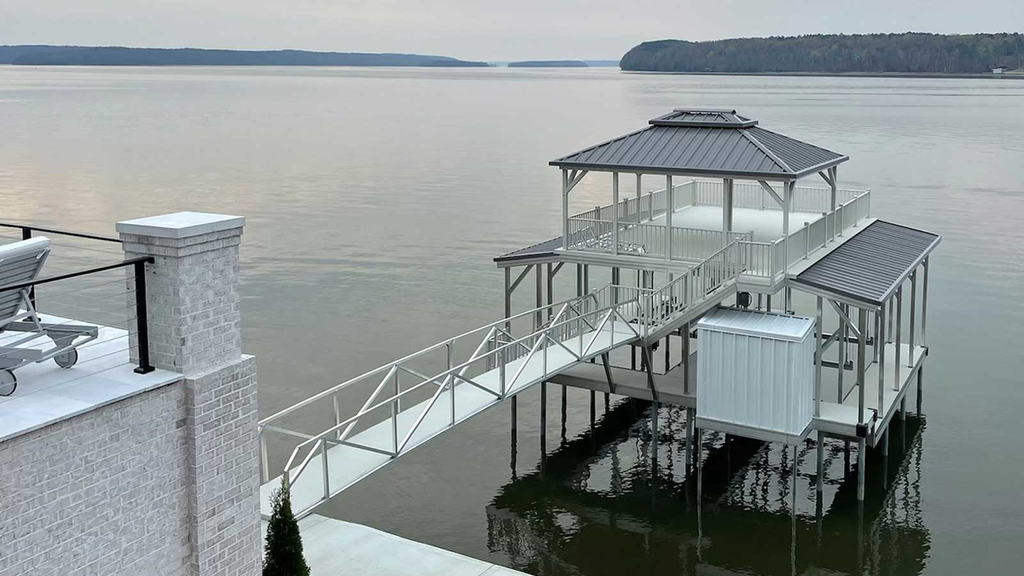
Wood is usually cheaper on day one. Aluminum costs more on that first invoice, and I won’t pretend it doesn’t. Then you start adding up what the dock asks of you afterward. Wood wants stain, new boards, hardware swaps, sometimes a rebuild somewhere around year ten to fifteen. Aluminum mostly wants a hose and a bolt check once in a while. Sections are lighter too, so shipping tends to be easier, and some owners put the whole thing together themselves over a weekend with a couple of friends. Over fifteen years, the price gap shrinks fast, and sometimes it flips. One warning though, and people ignore it constantly. Permits. Rules change by state, county, even by lake association, so call your local office before anything gets ordered. A dock rotting away in your driveway while paperwork drags is no fun.
Weather, Ice And The Water Itself
Weather is where aluminum shows off, with a few catches. Sun, rain, humidity, none of it bothers the metal. It won’t swell or split or grow mold. In salt or brackish water, rinse it off sometimes and stick with the hardware the maker recommends, because mixing the wrong metals can cause galvanic corrosion right at the connection points. Ice is another thing entirely. Moving ice wrecks wood docks and metal docks both, so find out early whether your model can stay in all winter or has to be pulled out. Open grid decking is nice since it lets light down to the plants and fish and drains fast, which means less of that slick green film. Heat on bare feet is the one downside, honestly, but lighter and textured decking helps quite a bit.
Putting A Roof Over It: Hip Roof Covered Boat Docks
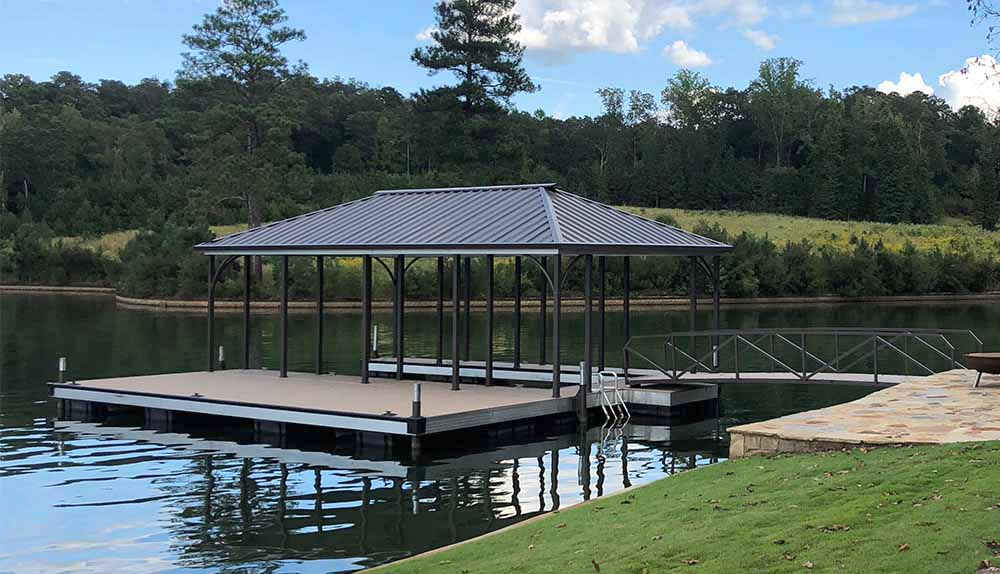
Once the dock itself is solid, a cover protects the expensive thing parked beside it. Hip roof covered boat docks slope down on all four sides, which makes a lower, sturdier shape than a gable. On open water that matters, since the wind has less flat surface to grab and rain and snow slide off in every direction. Your boat stays out of the worst sun and, yeah, the bird mess. The tradeoff is headroom. Those sloped ends can cut into the space for a tall boat or a tower, so get out a tape measure before you decide. A roof also adds weight and wind load, so the dock has to be built for it from the beginning. Don’t bolt a cover onto a frame that was never designed for one. And ask about snow load if you live up north.
So Which One Wins
For heavy boats over the long run, I’d go aluminum. It carries real weight, it doesn’t rot, and it stays strong without you giving up every spring to maintenance. Wood still works if your budget is tight and you’re willing to keep up with it; I’ll give it that. Whichever way you lean, look hard at the load rating, the connections and the anchoring, sort out permits early, and think about shade before the dock is built, not after. Also talk to somebody who builds and installs these every week, not somebody quoting a spec sheet. A team like Flotation Systems Aluminum Boat Dock can look at your water, your boat and your shoreline and tell you straight what’s going to hold up. That kind of honest advice beats any brochure, so ask the annoying questions now.
Frequently Asked Questions
1. Are aluminum docks strong enough for large boats?
Yes, when they’re properly engineered. Check the load rating and the anchoring, and match the dock to your boat’s weight and length.
2. Do aluminum docks last longer than wood?
Usually they do. With basic care, twenty to thirty years is common, while wood often needs big repairs a lot sooner.
3. Can aluminum docks handle waves and wake?
Generally yes. A good design and solid anchoring make a big difference, and fenders keep your boat from taking repeated hits.
4. Can I put a roof on my dock?
Often you can, but the frame has to be designed for the extra weight and wind. Hip roof covered boat docks are a popular, stable choice.
5. Do I need a permit for a new dock?
Most likely. Rules vary by state, county and lake association, so contact your local office before you order anything.